Monument FileDossier du Monument
- CemeteryCimetière Union Cemetery (Protestant burial ground), Fort Macleod, N.W.T./Alberta — established October 1874Cimetière Union (terrain de sépulture protestant), Fort Macleod, T.N.-O./Alberta — établi en octobre 1874
- Field of HonourChamp d’Honneur 41 marked graves within a white picket fence, N.W.M.P./R.N.W.M.P./R.C.M.P. section41 tombes identifiées à l’intérieur d’une clôture blanche à piquets, section P.C.N.-O./G.R.C.N.-O./G.R.C.
- Earliest DeathPremier Décès Constable Godfrey Parks, remembered locally as “Primus Moriri” (first to die), of typhoid contracted on the Great March; died October 26, 1874Le gendarme Godfrey Parks, connu localement comme le « Primus Moriri » (premier à mourir), de la fièvre typhoïde contractée durant la Grande Marche; décédé le 26 octobre 1874
- Monument CommissionedMonument Commandé Autumn 1894, by the North West Mounted Police, Fort MacleodAutomne 1894, par la Police à Cheval du Nord-Ouest, Fort Macleod
- ManufacturerFabricant The White Bronze Monument Company, St. Thomas, OntarioThe White Bronze Monument Company, St. Thomas, Ontario
- Local AgentAgent Local E. McFarquhar, Fort Macleod
- MaterialMatériau Cast “white bronze” (zinc)« Bronze blanc » moulé (zinc)
- DimensionsDimensions Approx. 20 feet overall; upper shaft approx. 12 feet, set on a square baseEnviron 20 pieds au total; fût supérieur d’environ 12 pieds, sur une base carrée
- InscriptionInscription “Canada; erected to the memory of their deceased comrades, by the N.W.M. Police, Fort Macleod.”« Canada; erected to the memory of their deceased comrades, by the N.W.M. Police, Fort Macleod. » (inscription originale, en anglais)
- Companion MonumentMonument Jumeau A smaller copy, erected the same year in the adjoining Roman Catholic burial groundUne copie plus petite, érigée la même année dans le terrain de sépulture catholique romain adjacent
- Combined WeightPoids Combiné Approx. two tons, both monuments togetherEnviron deux tonnes, les deux monuments ensemble
- Combined CostCoût Combiné In the neighbourhood of $700, laid downDans les environs de 700 $, installation comprise
- Old-Timers at Rest HereVétérans Reposant Ici Sub-Cst. John Nash, Reg.#135, Honour Roll #1 (d. Mar. 11, 1876); Cst. Frank Baxter & Cst. Thomas Wilson (lost together in a blizzard between Fort Macleod and Fort Kipp); Cst. Claudius S. Hooley, Reg.#181, Honour Roll #4 (d. Jul. 24, 1880); Spl./Cst. Jerry Potts, Interpreter & Guide of the Great March (d. Jul. 13, 1896); Brigadier Frederick Harvey, V.C., M.C. (d. 1980)Sous-const. John Nash, matr. 135, Tableau d’Honneur n°1 (déc. 11 mars 1876); gend. Frank Baxter et gend. Thomas Wilson (perdus ensemble dans une tempête de neige entre Fort Macleod et Fort Kipp); gend. Claudius S. Hooley, matr. 181, Tableau d’Honneur n°4 (déc. 24 juillet 1880); gend. spécial Jerry Potts, interprète et guide de la Grande Marche (déc. 13 juillet 1896); brigadier Frederick Harvey, C.V., M.C. (déc. 1980)
- Newspaper SourceSource Journalistique Macleod Gazette, reprinted in the South Edmonton News, Thursday, December 27, 1894, p.2Macleod Gazette, réimprimé dans le South Edmonton News, jeudi 27 décembre 1894, p.2
- Submitted BySoumis Par RCMP Alberta Volunteer Alison GlassVétéran(e) bénévole GRC Alberta, Alison Glass
Erected to the Memory of Their Deceased Friends
Stand today in the older ground of Union Cemetery in Fort Macleod, and it is impossible to miss: a shaft of cast white bronze rising twenty feet above the surrounding stones, its square base marked on every side with the crest of a Force that has changed its name twice since the metal was first poured…
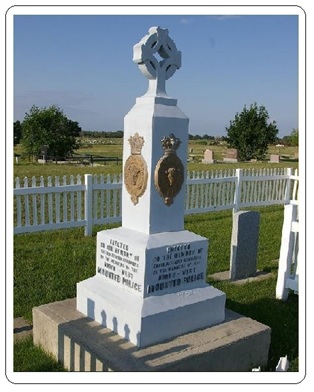
The Monument Marker, N.W.M.P. Field of Honour,
Union Cemetery, Fort Macleod
Photo courtesy of J.J. Healy
The ground beneath the monument is older than the monument itself by two decades. The North West Mounted Police reached the forks of the Oldman and Belly rivers in October 1874, the footsore end of the Great March west from Dufferin, Manitoba — some 1,200 kilometres of open prairie that had worn down men, horses, and wagons in roughly equal measure. The very first casualty came within two weeks of arrival. Constable Godfrey Parks, who had contracted typhoid fever somewhere on the trail, died on October 26, 1874, and was buried on the island site the Force first called home. Fort Macleod’s own histories remember him still as the Primus Moriri — the first to die.
Others followed him into that same ground over the next twenty years, each grave at first marked only by a wooden cross. Local memory holds that Constable Frank Baxter and Constable Thomas Wilson, caught together in a blizzard on the trail between Fort Macleod and Fort Kipp, were among the earliest of the Force to be lost this way. Sub-Constable John Nash, Regimental #135, was thrown from an overturned wagon while out gathering firewood and struck by a falling log; he died March 11, 1876, and became the first name formally entered on the N.W.M.P. Honour Roll — the only member of the original Great March to be included on it. Constable Claudius S. Hooley, Regimental #181, Honour Roll #4, died July 24, 1880, riding with Commissioner James Macleod and guide Jerry Potts on the trail from Fort Walsh.
By 1894, twenty years after the Force first pitched its tents on the Oldman River, those wooden crosses were weathered nearly past reading. That autumn, the North West Mounted Police at Fort Macleod ordered something meant to outlast them: two cast monuments, one for the Protestant burial ground and a smaller companion for the adjoining Roman Catholic ground — today known as Holy Cross Cemetery — purchased from the White Bronze Monument Company of St. Thomas, Ontario, through the firm’s local agent, E. McFarquhar.
From the Macleod Gazette, reprinted in the South Edmonton News, Thursday, December 27, 1894, p.2 — shared by RCMP Alberta Volunteer Alison Glass
“The monuments erected in memory of deceased members of the N.W.M.P. arrived some days ago and are now in position in the cemeteries. There are two of them; one for the Protestant burial ground and one for the R.C. ground. The former is the shape of an obelisk, and stands about twenty feet high. The upper shaft is about twelve feet, and it stands on square base, on each side of which are the arms of the N.W.M.P., and the following inscription: ‘Canada; erected to the memory of their deceased comrades, by the N.W.M. Police, Fort Macleod.’ It is cast in white bronze, and was obtained from the White Bronze Monument company, of St. Thomas, Ont., through their agent here, E. McFarquhar. The second one is a small copy of the other. Together they weighed about two tons, and cost, laid down, in the neighborhood of $700.”
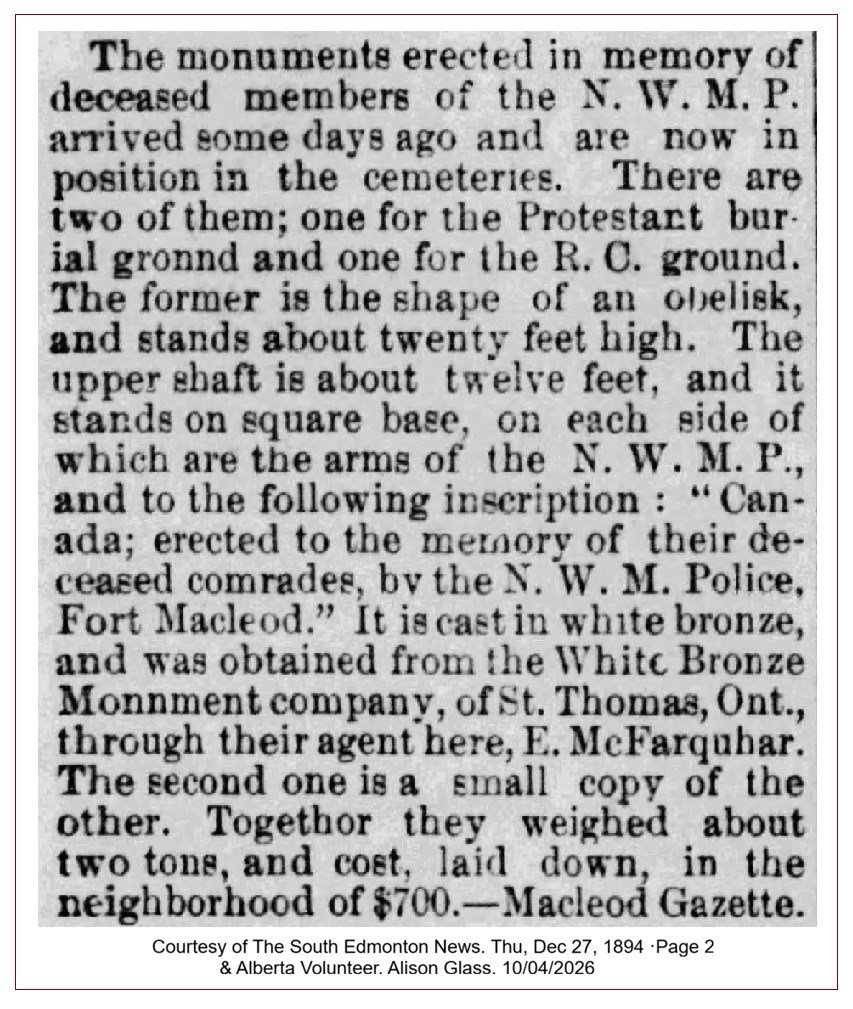
The South Edmonton News, Thu., Dec. 27, 1894, p.2
Courtesy of RCMP Alberta Volunteer Alison Glass
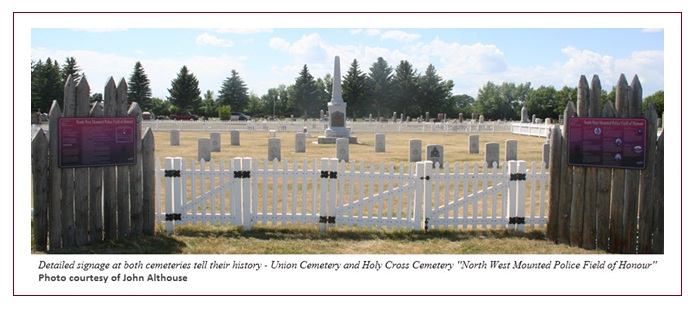
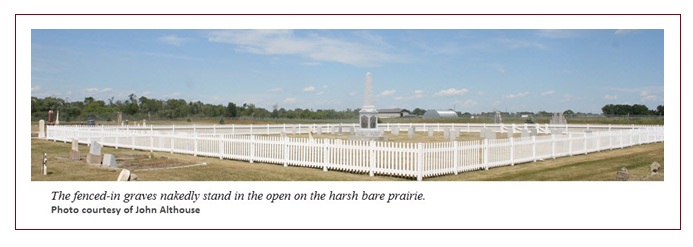
The gated entrance to the Field of Honour, with the obelisk visible at centre
Photo courtesy of John Althouse
Seven hundred dollars was no small sum for a frontier police force to find in 1894, and it says something about how the Force wished to be remembered that it found the money anyway. What arrived by rail and wagon that autumn was not a granite monument — granite was costlier still, and harder to move west — but a monument cast in zinc and finished to resemble bronze, a popular and comparatively affordable choice for cemeteries across North America at the time. Two tons of it, between the two markers, raised over the men the Force had already buried and the men it had not yet lost.
The monument did not stand watch over strangers. Special Constable Jerry Potts, the Force’s interpreter and guide, had led the exhausted column of the Great March into this same country in 1874; he died July 13, 1896, not two years after the monument went up, and was buried among the men he had once guided in. Decades later still, in a very different century of war, Brigadier Frederick Harvey — a Victoria Cross recipient of Lord Strathcona’s Horse, decorated too with the Military Cross and the Croix de Guerre — came to rest in the same Field of Honour in 1980. Two very different careers, eighty-four years apart, ending under the sight of the same twenty-foot shaft of white bronze.
The monument stands there still, weathered but legible, in the older ground at Union Cemetery. This August, we remember it not as one veteran’s story but as all of theirs at once — the wooden crosses it was built to replace, the old-timers named on the sign beside it, and the ones who arrived long after the metal had already gone green with age. Our thanks, this month, go to RCMP Alberta Volunteer Alison Glass, who found the December 1894 clipping in the pages of the South Edmonton News and sent it along so that this small piece of the story could be told again.
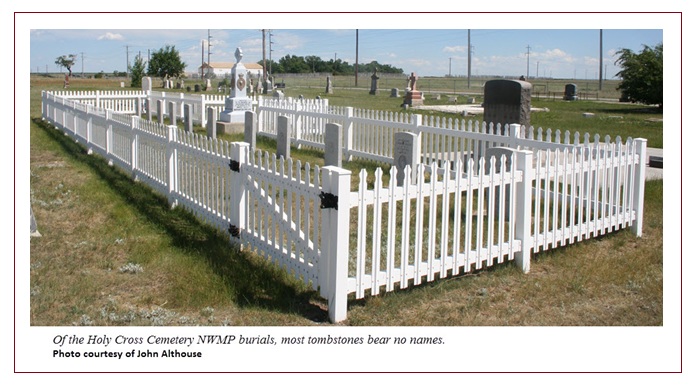
The companion monument’s ground: N.W.M.P. burials at Holy Cross Cemetery — most tombstones here bear no names
Photo courtesy of John Althouse
Érigé à la Mémoire de Leurs Camarades Décédés
Le Monument, Cimetière Union
Fort Macleod · 1894–
Photo gracieuseté de John Althouse
Tenez-vous aujourd’hui dans la partie ancienne du cimetière Union à Fort Macleod, et il est impossible de le manquer : un fût de bronze blanc moulé s’élevant à vingt pieds au-dessus des pierres environnantes, sa base carrée marquée sur chaque face de l’insigne d’une Force qui a changé de nom deux fois depuis que le métal fut coulé…
Le Marqueur du Monument, Champ d’Honneur de la P.C.N.-O., Cimetière Union, Fort Macleod
Photo gracieuseté de J.J. Healy
Le sol sous le monument est plus ancien que le monument lui-même de deux décennies. La Police à Cheval du Nord-Ouest atteignit la fourche des rivières Oldman et Belly en octobre 1874, terme épuisant de la Grande Marche vers l’ouest depuis Dufferin, au Manitoba — quelque 1 200 kilomètres de prairie à découvert qui avaient usé hommes, chevaux et chariots à parts à peu près égales. La toute première perte survint dans les deux semaines suivant l’arrivée. Le gendarme Godfrey Parks, ayant contracté la fièvre typhoïde quelque part sur la piste, mourut le 26 octobre 1874, et fut enterré sur le site insulaire que la Force appela d’abord son foyer. Les histoires locales de Fort Macleod se souviennent encore de lui comme le Primus Moriri — le premier à mourir.
D’autres le suivirent dans ce même sol au cours des vingt années suivantes, chaque tombe d’abord marquée seulement d’une croix de bois. La mémoire locale veut que le gendarme Frank Baxter et le gendarme Thomas Wilson, pris ensemble dans une tempête de neige sur la piste entre Fort Macleod et Fort Kipp, aient compté parmi les premiers de la Force à être perdus de cette façon. Le sous-constable John Nash, matricule 135, fut projeté d’un chariot renversé alors qu’il ramassait du bois de chauffage et frappé par une bûche qui tombait; il mourut le 11 mars 1876, et devint le premier nom formellement inscrit au Tableau d’Honneur de la P.C.N.-O. — le seul membre de la Grande Marche originale à y figurer. Le gendarme Claudius S. Hooley, matricule 181, Tableau d’Honneur n°4, mourut le 24 juillet 1880, chevauchant avec le commissaire James Macleod et le guide Jerry Potts sur la piste depuis Fort Walsh.
En 1894, vingt ans après que la Force eut planté ses tentes pour la première fois sur la rivière Oldman, ces croix de bois étaient usées presque au point d’être illisibles. Cet automne-là, la Police à Cheval du Nord-Ouest de Fort Macleod commanda quelque chose destiné à leur survivre : deux monuments coulés, l’un pour le terrain de sépulture protestant et un plus petit compagnon pour le terrain catholique romain adjacent — aujourd’hui connu sous le nom de cimetière Holy Cross — achetés auprès de la White Bronze Monument Company de St. Thomas, en Ontario, par l’entremise de l’agent local de la firme, E. McFarquhar.
Du Macleod Gazette, réimprimé dans le South Edmonton News, jeudi 27 décembre 1894, p.2 — partagé par la vétéran(e) bénévole GRC Alberta, Alison Glass
« Les monuments érigés à la mémoire des membres décédés de la P.C.N.-O. sont arrivés il y a quelques jours et sont maintenant en place dans les cimetières. Il y en a deux; un pour le terrain de sépulture protestant et un pour le terrain catholique romain. Le premier a la forme d’un obélisque, et s’élève à environ vingt pieds de haut. Le fût supérieur mesure environ douze pieds, et repose sur une base carrée, sur chaque face de laquelle se trouvent les armes de la P.C.N.-O., avec l’inscription suivante : ‘Canada; erected to the memory of their deceased comrades, by the N.W.M. Police, Fort Macleod.’ Il est coulé en bronze blanc, et fut obtenu de la White Bronze Monument company, de St. Thomas, Ont., par l’entremise de leur agent ici, E. McFarquhar. Le second est une copie plus petite de l’autre. Ensemble ils pesaient environ deux tonnes, et coûtèrent, installation comprise, dans les environs de 700 $. »
Le South Edmonton News, jeu. 27 déc. 1894, p.2
Gracieuseté de la vétéran(e) bénévole GRC Alberta, Alison Glass
L’entrée grillagée du Champ d’Honneur, avec l’obélisque visible au centre
Photo gracieuseté de John Althouse
Sept cents dollars n’étaient pas une mince somme à trouver pour une force policière de la frontière en 1894, et cela en dit long sur la manière dont la Force souhaitait être commémorée qu’elle ait tout de même trouvé l’argent. Ce qui arriva par train et par chariot cet automne-là n’était pas un monument de granit — le granit coûtait encore plus cher, et était plus difficile à transporter vers l’ouest — mais un monument coulé en zinc et fini pour ressembler au bronze, un choix populaire et relativement abordable pour les cimetières à travers l’Amérique du Nord à l’époque. Deux tonnes de cela, entre les deux marqueurs, s’élevèrent au-dessus des hommes que la Force avait déjà enterrés et de ceux qu’elle n’avait pas encore perdus.
Le monument ne veillait pas sur des étrangers. Le gendarme spécial Jerry Potts, interprète et guide de la Force, avait conduit la colonne épuisée de la Grande Marche dans ce même pays en 1874; il mourut le 13 juillet 1896, moins de deux ans après l’érection du monument, et fut enterré parmi les hommes qu’il avait autrefois guidés. Des décennies plus tard, dans un siècle bien différent de guerre, le brigadier Frederick Harvey — récipiendaire de la Croix de Victoria au sein du Lord Strathcona’s Horse, décoré aussi de la Croix militaire et de la Croix de guerre — vint reposer dans ce même Champ d’Honneur en 1980. Deux carrières bien différentes, séparées de quatre-vingt-quatre ans, se terminant sous le regard du même fût de vingt pieds de bronze blanc.
Le monument s’y dresse encore, usé par le temps mais lisible, dans la partie ancienne du cimetière Union. Ce mois d’août, nous nous en souvenons non pas comme de l’histoire d’un seul vétéran, mais de toutes leurs histoires à la fois — les croix de bois qu’il fut bâti pour remplacer, les vétérans nommés sur l’enseigne à ses côtés, et ceux qui arrivèrent longtemps après que le métal eut déjà verdi avec l’âge. Nos remerciements, ce mois-ci, vont à la vétéran(e) bénévole GRC Alberta, Alison Glass, qui a retrouvé la coupure de décembre 1894 dans les pages du South Edmonton News et nous l’a fait parvenir afin que ce petit pan de l’histoire puisse être raconté à nouveau.
Le terrain du monument jumeau : sépultures de la P.C.N.-O. au cimetière Holy Cross — la plupart des pierres tombales ici ne portent aucun nom
Photo gracieuseté de John Althouse
The Monument · 1894 · Union Cemetery, Fort Macleod · R.I.P. Le Monument · 1894 · Cimetière Union, Fort Macleod · R.I.P.
This story was composed from “The Monuments Erected in Memory of Deceased Members of the N.W.M.P.,” Macleod Gazette, reprinted in The South Edmonton News, Thursday, December 27, 1894, p.2 (shared by RCMP Alberta Volunteer Alison Glass); signage and burial notes for the N.W.M.P. Field of Honour, Union Cemetery, Fort Macleod; “The North West Mounted Police Cemeteries at Fort Macleod,” Alberta Genealogical Society; Find a Grave records for Union Cemetery, Fort Macleod, including memorials for Sub-Cst. John Nash, Cst. Claudius S. Hooley, Spl/Cst. Jerry Potts, and Brigadier Frederick Harvey, V.C.; the Canadian Great War Project record for Lt. Frederick M.W. Harvey, V.C.; and monument photographs courtesy of John Althouse and J.J. Healy. Cette histoire a été composée à partir de « The Monuments Erected in Memory of Deceased Members of the N.W.M.P., » Macleod Gazette, réimprimé dans The South Edmonton News, jeudi 27 décembre 1894, p.2 (partagé par la vétéran(e) bénévole GRC Alberta, Alison Glass); des enseignes et notes de sépulture du Champ d’Honneur de la P.C.N.-O., Cimetière Union, Fort Macleod; de « The North West Mounted Police Cemeteries at Fort Macleod, » Alberta Genealogical Society; des dossiers Find a Grave du Cimetière Union, Fort Macleod, incluant les mémoriaux du sous-const. John Nash, du gend. Claudius S. Hooley, du gend. spécial Jerry Potts, et du brigadier Frederick Harvey, C.V.; du dossier du Canadian Great War Project pour le lt. Frederick M.W. Harvey, C.V.; et des photographies du monument gracieuseté de John Althouse et J.J. Healy.
Structure & Drafting Assistance: Claude AI (Anthropic) Structure et Rédaction Assistée : Claude AI (Anthropic)