Service File Dossier de service
- Reg. #Matr. # 12398
- RankGrade Corporal · RCMP · No. 1 Provost Company Caporal · GRC · No. 1 Compagnie provôtale
- NameNom John Francis Joseph Nelson
- BornNé 1910 · Halifax, NS · Graduate, St. Mary’s University, Halifax 1910 · Halifax, N.-É. · Diplômé, Université Saint-Mary’s, Halifax
- RCMP ServiceService GRC Joined 1934 · Age 24 · Basic Training, Regina, SK · Transferred to Toronto · Federal statutes enforcement Entrée 1934 · 24 ans · Formation de base, Regina, SK · Transféré à Toronto · Application des lois fédérales
- WWII ServiceService WWII Volunteered early 1941 · Service #C.30819 · Fifth Reinforcement Draft, RCMP Provost Corps · Departed for Europe March 1941 · No. 1 Provost Company, 1st Canadian Infantry Division · Sicily invasion July 10, 1943 · Italian campaign Volontaire début 1941 · No. de service #C.30819 · Cinquième contingent de renfort, Corps provôtal GRC · Départ pour l’Europe mars 1941 · No. 1 Compagnie provôtale, 1re Division d’infanterie canadienne · Invasion de la Sicile, 10 juillet 1943 · Campagne d’Italie
- Killed in ActionTué au combat May 22, 1944 · Age 33 · “Heart Route” south of Rome, Italy · 88mm artillery shell 22 mai 1944 · 33 ans · “Heart Route” au sud de Rome, Italie · Obus d’artillerie de 88 mm
- BuriedInhumé Cassino War Cemetery · Abbey of Monte Cassino, Italy · Name also etched on Nelson family plot, Gate of Heaven Cemetery, Sackville, NS Cimetière de guerre de Cassino · Abbaye du Mont-Cassin, Italie · Nom aussi gravé sur le lot familial Nelson, cimetière Gate of Heaven, Sackville, N.-É.
- Honour RollTableau d’Honneur RCMP Honour Roll #82 Tableau d’honneur de la GRC #82

Canada is in trouble. History is no longer prioritized in high school, instead it has been swept away by competitive sports, endless computer courses, modern dance and costly school trips. This is a sad situation for all Canadians. As a consequence, while the role and record of the RCMP in Europe during WWII is generally well known among Canadian researchers and historians, high school students are most likely not aware of such important events that shaped Canada. The study of history is related to all sorts of essential choices which young people confront every day, but high school students are missing out. This short story recalls the life and death of RCMP Corporal John Francis Joseph Nelson. He was killed in action in Italy during WWII. War veterans of Nelson’s stature deserve to be remembered by all Canadians, and especially students enrolled in high school.
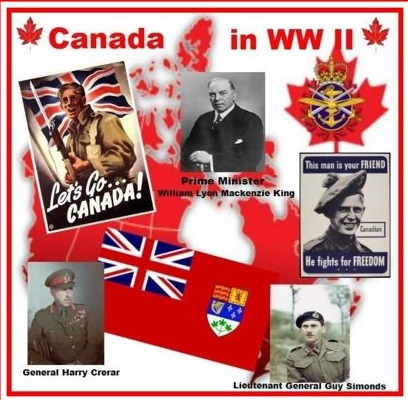
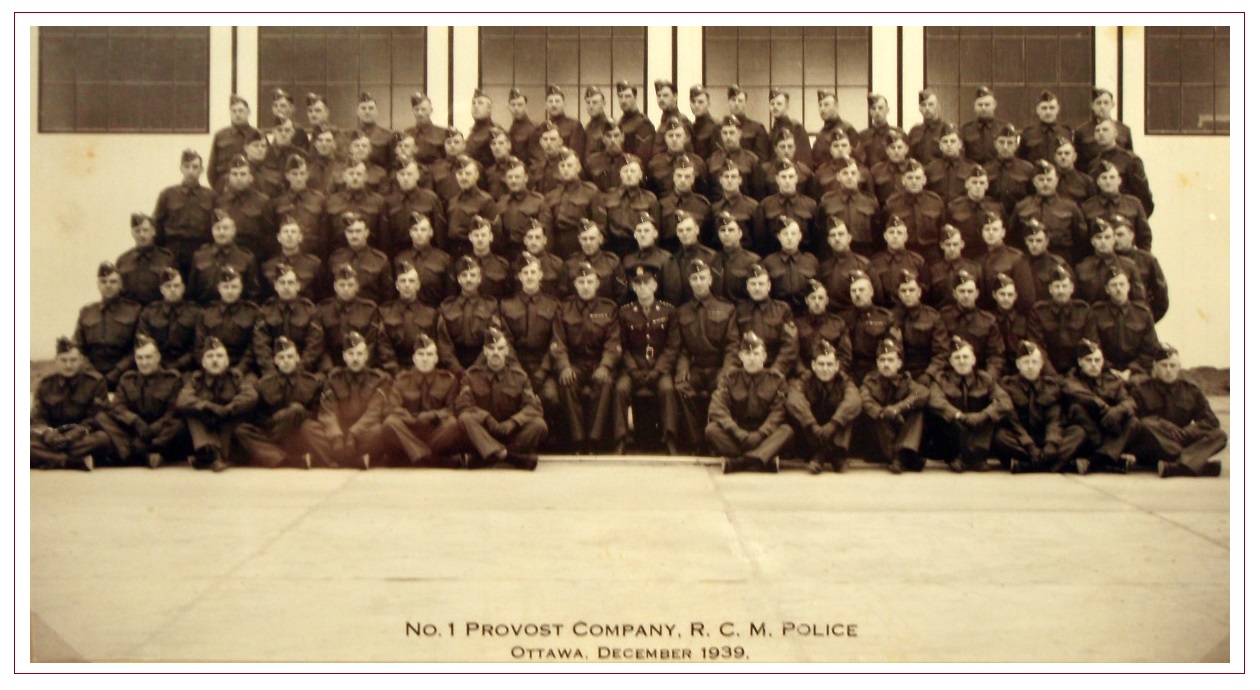
In 1939, at the outbreak of WWII, hundreds of active RCMP members wanted to volunteer, to enlist and be sent to Europe. At the time, the Canadian Army did not have a police component embedded within it, and this deficiency was well recognized by the government. On September 13, 1939, RCMP Commissioner Stuart Taylor Wood requested and received permission to form a Provost Company using volunteers from RCMP ranks. This group of RCMP was designated the No 1 Provost Company (RCMP) of the 1st Canadian Infantry Division. The No 1 Provost Company (RCMP) was composed of 120 men and by the end of 1939 most of them were already in the United Kingdom undergoing advanced training which would prepare them for live action, and increase their chances to escape serious injury or even death. Throughout the war, several more Reinforcement Drafts of RCMP members would be sent to Europe.
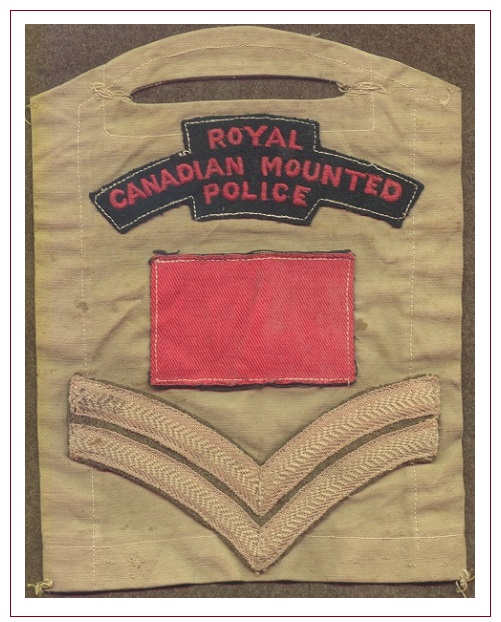
The duties of the Provost Corps were critical, varied and fraught with danger. According to The Canadian Provost Corps website, author James D. Lumsden, CD, listed their essential duties; to analyze the capacity and adequacy of routes; to control traffic, to identify whether or not RCMP resources were adequate, to guard, and escort prisoners, and to control refugee movements. In a combat zone, these duties put the RCMP Provost at a higher level of risk. The RCMP were well trained for their policing role in Canada, but Provost duties in a combat environment were far more perilous. There was no rest from the possibility of injuries or death. Provost duties required a higher level of courage and resilience which few men possessed yet this was the uncertain and unstable environment which Corporal Nelson volunteered to undertake.
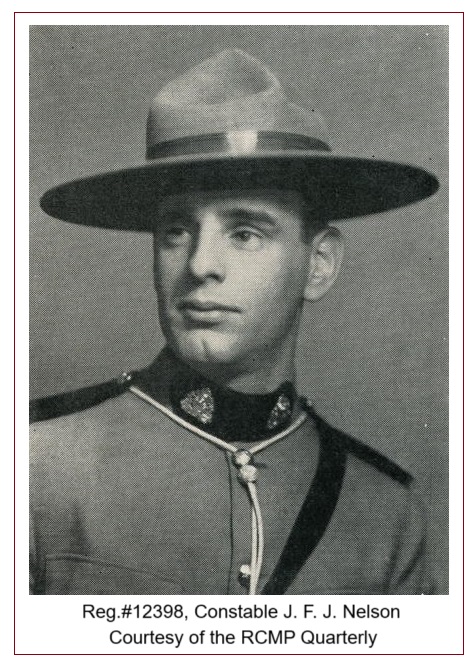
John Francis Joseph Nelson was born in Halifax, NS in 1910. After graduating from St. Mary’s University in Halifax, Nelson joined the RCMP in 1934. He underwent Basic Recruit Training in Regina, SK, then he was transferred to Toronto where he served in enforcing federal statutes. In early 1941, Nelson volunteered for the Provost Corps. He was assigned Service #C. 30819. Nelson and the Fifth Reinforcement Draft of the RCMP Provost Corps departed for Europe in March, 1941.
Nelson’s education set him apart from his closest RCMP chums. What made him unique was a university degree from St Mary’s in Halifax, NS — historically, the school’s reputation rested on having outstanding programs in business and science. Nelson would have had to be an excellent student to meet the entrance requirements of St. Mary’s. In 1934, he was a little older than most recruits who joined the RCMP — he was 24 years of age and his maturity and leadership qualities set him apart. He was reputed to be highly trustworthy, and he often worked alone. Nelson was highly devoted to the RCMP, and the policing profession. Overall, Nelson was the type of police officer who was in demand because he exhibited the very best of character traits as well as highly sought after personal qualities — an independent and clear thinker. John Nelson was tailor-made for the Provost Corps. He was promoted to Corporal.
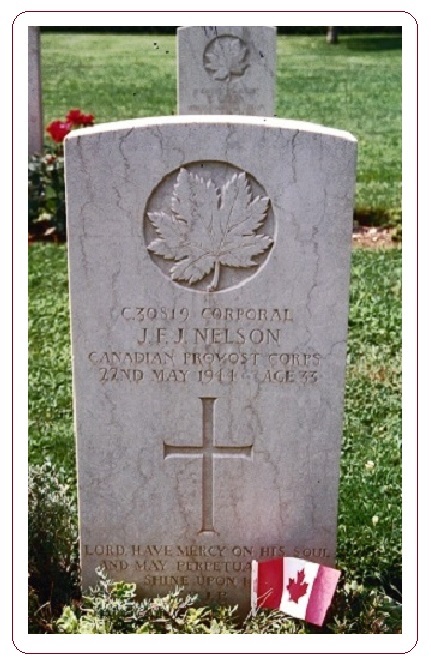
On July 10th, 1943, the 1st Canadian Infantry Division and No. 1 Provost Company participated in the Sicily invasion and the landing on the Italian mainland. Over the ensuing weeks, the Division fought its way up the Italian countryside. According to RCMP accounts, on the day Nelson was killed, he was directing traffic at an intersection on the main north/south highway south of Rome known as the “Heart Route”. Due to the allied push north through Italy the road was constantly congested with military traffic, infantry and long lines of prisoners of war. The environment was loud, chaotic and unpredictable. As Nelson was doing his best to keep the flow of traffic moving, the Germans unexpectedly launched an artillery barrage. A 88mm shell burst beside Constable Nelson’s jeep. He was killed instantly. It was May 22, 1944. John Nelson was 33 years of age. He was buried in the Cassino War Cemetery at the Abbey of Monte Cassino in Italy.
John Nelson is remembered as an exceptional Canadian hero — as a police officer and as a Provost. He volunteered to enlist in WWII, and to be sent to Europe with the No 1 Provost Corps fully aware of the risks to his own life. He exhibited all the good qualities of a leader; fearless, confident, and brave. He was aware of the unpredictable nature of working in a war zone, yet he was undaunted. He led an inspirational life as a young man, and as a Canadian. High school students should know John Nelson’s name.
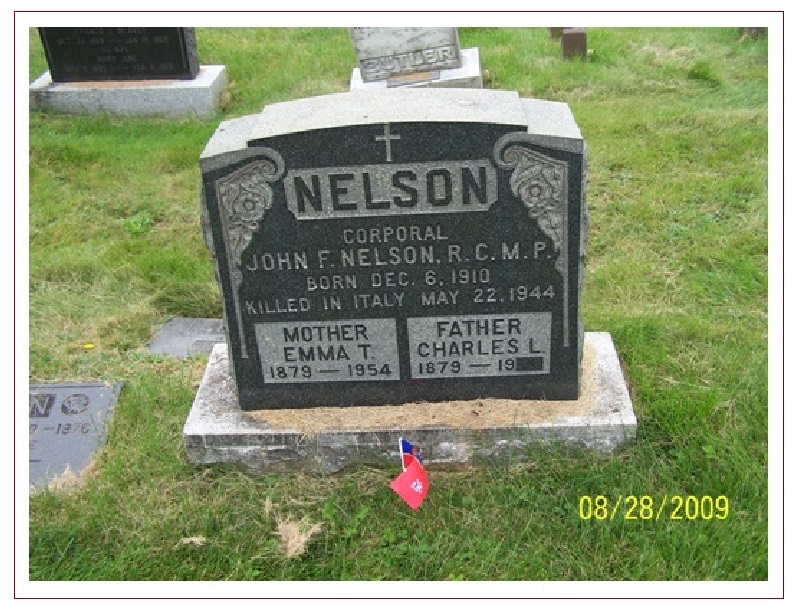
Nelson family marker · Gate of Heaven Cemetery · Sackville, NS
Courtesy of RCMP Veterans, Nova Scotia
Although Corporal John Nelson was buried in Italy, his parents later etched his name on their family plot in the Gate of Heaven Cemetery in Sackville, NS. The photo of the Nelson marker was courtesy of the RCMP Veterans in Nova Scotia.
Corporal John Nelson is listed as #82 on the RCMP Honour Roll.
J. J. Healy
September 23, 2024
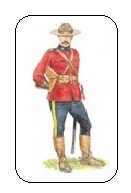
Reg.#12398 · Corporal John Francis Joseph Nelson · WWII · KIA · Honour Roll #82 · Vet of the Month · September 2024 · rcmpgraves.com Matr.#12398 · Caporal John Francis Joseph Nelson · WWII · TCA · Tableau d’Honneur #82 · Vétéran du Mois · Septembre 2024 · rcmpgraves.com
↑ Back to Top ↑ Retour en Haut ← Back to Vet of the Month ← Retour au Vétéran du Mois